
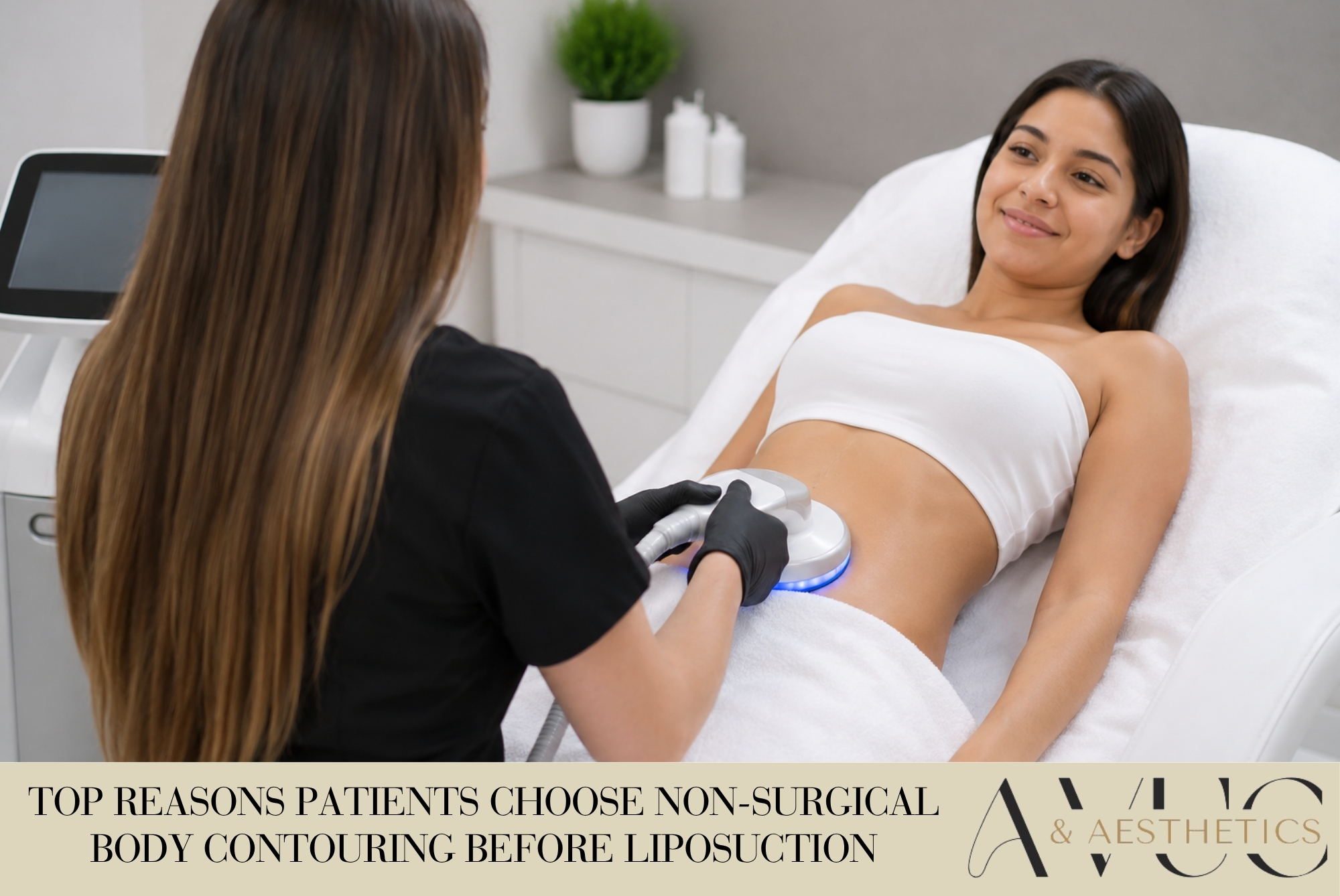
 For people who have stubborn areas of fat that do not seem to respond to diet and exercise, body contouring can offer another option for improving shape and definition. However, choosing a cosmetic treatment does not automatically mean choosing surgery.
Many patients begin by exploring non-surgical body contouring before liposuction because they want to understand whether a less invasive approach can address their cosmetic goals. Non-surgical treatments can target certain localized areas without surgical incisions, while liposuction is an invasive procedure that physically removes fat through a small incision.
According to the U.S. Food and Drug Administration (FDA), non-invasive body contouring encompasses several technologies designed to change the appearance or circumference of a treatment area. Depending on the technology, treatment may target small amounts of excess fat, cellulite, muscle tone, or skin appearance. Importantly, non-invasive body contouring is not a weight-loss treatment and does not treat obesity.
At Apricot Valley Urgent Care & Aesthetics, patients in Patterson, Modesto, and surrounding Central Valley communities can discuss their aesthetic goals with a healthcare professional and determine whether a non-surgical approach may be appropriate for them.
What Is Non-Surgical Body Contouring?
Non-surgical body contouring, sometimes called non-invasive body contouring or body sculpting, refers to cosmetic procedures intended to alter the appearance of specific areas of the body without traditional surgery.
Depending on the device and its intended use, technologies may use controlled cooling, radiofrequency energy, light-based energy, ultrasound, magnetic fields, or other mechanisms. The goal varies by treatment and may include reducing a localized fat bulge, temporarily reducing circumference, improving the appearance of cellulite, or improving muscle tone or firmness.
Unlike liposuction, non-invasive body contouring does not physically suction fat from the body through an incision.
Non-Surgical Body Contouring vs. Liposuction
The most important distinction is that these treatments are fundamentally different procedures.
Liposuction is surgery. A narrow tube is inserted through a small incision and used to remove subcutaneous fat. Non-invasive body contouring, by contrast, is performed at the skin’s surface and does not surgically remove tissue.
The American Society of Plastic Surgeons (ASPS) emphasizes that non-surgical fat-reduction treatments should not be considered replacements for liposuction. Instead, they provide alternatives for certain patients who may not want or be able to undergo surgery.
That distinction is important when setting realistic expectations.
Top Reasons Patients Consider Non-Surgical Body Contouring Before Liposuction
1. They Want to Explore a Less Invasive Option First
One of the most common reasons patients investigate non-surgical body contouring is straightforward: they would prefer to avoid surgery when possible.
Liposuction requires small incisions and the surgical removal of fat. Non-invasive body contouring is performed without surgical incisions.
For a patient primarily concerned with a relatively small or localized area, it may therefore make sense to discuss whether a non-surgical option can reasonably address the concern before considering an operation.
The right approach depends on the treatment area, amount and type of fat, skin characteristics, health history, expectations, and desired degree of change.
2. They Want Less Interruption to Their Routine
Recovery requirements can play a major role in cosmetic treatment decisions.
Because liposuction is surgery, patients should anticipate a postoperative recovery period. Swelling and discomfort can occur after the procedure, and individual recovery recommendations depend on the extent of treatment and surgical technique.
Non-surgical procedures generally avoid the surgical recovery associated with incisions and tissue removal. This can make them appealing to people balancing work, family, travel, exercise, and other commitments.
However, “non-surgical” does not mean completely risk-free or symptom-free. The FDA notes that body contouring devices can cause effects such as discomfort, redness, swelling, bruising, or palpable nodules, with additional risks depending on the technology.
3. Their Concern Is a Localized Area Rather Than Overall Weight
Body contouring is fundamentally about shape rather than weight loss.
A patient may be generally satisfied with their weight yet remain bothered by a localized bulge or area that looks disproportionate to the rest of the body.
This distinction matters because neither non-surgical body contouring nor liposuction should be viewed as a substitute for medically appropriate weight management.
The FDA specifically states that non-invasive body contouring does not treat obesity and does not provide the health benefits associated with weight loss.
Similarly, liposuction is intended for body contouring rather than as a primary weight-loss procedure. ASPS notes that liposuction targets subcutaneous fat rather than visceral fat surrounding the abdominal organs.
4. They Prefer Gradual Changes
Some patients prefer cosmetic improvements that develop gradually rather than the more immediate structural change associated with surgically removing fat.
The timeline depends heavily on the technology.
For example, the FDA explains that with cryolipolysis, damaged fat cells are gradually cleared by the body’s immune system, generally over approximately two to three months. Other technologies work through different biological mechanisms and therefore have different treatment schedules and timelines.
Patients considering body contouring should ask how soon changes may become noticeable, how many sessions may be recommended, and whether maintenance treatments could eventually be needed.
5. They Want to Evaluate Their Response Before Considering Surgery
A conservative treatment pathway can appeal to patients who are uncertain whether they want cosmetic surgery.
Beginning with a non-surgical consultation allows a patient to learn what can realistically be accomplished without surgery. If the expected improvement aligns with the patient’s goals, a non-surgical approach may be worth considering.
If the desired degree of fat reduction or contour change exceeds what non-invasive treatment can reasonably provide, liposuction or another surgical procedure may ultimately be more appropriate.
The important point is that the decision should be based on anatomy and realistic outcomes—not simply on which procedure sounds easier.
6. They Are Concerned About Surgical Downtime
Any surgical procedure introduces recovery considerations that are not identical to those associated with a non-invasive treatment.
For some patients, the ability to avoid an operation and its associated recovery is a significant advantage. This can be especially relevant for people who cannot easily take extended time away from professional or personal responsibilities.
Patients should nevertheless avoid assuming that every non-surgical procedure has zero downtime. Temporary redness, swelling, bruising, discomfort, tenderness, or other effects can occur depending on the technology and treatment area.
7. They Want a Treatment Plan Tailored to a Specific Area
Modern aesthetic medicine offers multiple approaches to body contouring because not every cosmetic concern is the same.
A small pocket of subcutaneous fat, cellulite, concerns about muscle definition, and loose-appearing skin represent different aesthetic issues. A treatment designed for one concern may not be appropriate for another.
The FDA describes technologies intended for different effects, including reducing localized fat bulges, temporarily reducing circumference or cellulite appearance, and improving muscle tone and firmness.
A professional evaluation can help clarify what is actually contributing to the appearance of an area before a treatment is selected.
8. They Are Not Ready to Commit to Liposuction
Cosmetic surgery is a significant personal decision.
Someone may be interested in improving body contours while remaining uncertain about undergoing surgery. Exploring non-surgical options first gives that patient an opportunity to understand the possibilities and limitations of less invasive treatments.
For some people, a non-surgical approach may provide an acceptable degree of improvement. Others may decide that their goals require the greater degree of fat removal achievable with liposuction.
Neither decision is inherently better. The appropriate choice depends on the individual.
9. They Understand That Bigger Changes Are Not Always the Goal
A successful cosmetic treatment is not necessarily the treatment that produces the largest possible change.
Some patients want a subtle refinement of one area rather than dramatic reshaping. In those circumstances, a non-surgical treatment may be worth discussing.
Patients seeking more substantial removal of localized fat, however, should understand that non-surgical treatments have limitations. ASPS specifically notes that non-surgical fat reduction is not a replacement for liposuction.
Setting this expectation before treatment helps patients compare their options more realistically.
10. They Want to Understand All Available Options Before Making a Decision
An informed patient does not have to decide between “surgery” and “no treatment.”
There may be multiple approaches between those two choices.
Discussing non-surgical body contouring first can help patients understand what treatment can accomplish, what it cannot accomplish, possible risks, anticipated timelines, and whether their desired outcome is realistic.
The FDA recommends discussing benefits and risks with a healthcare provider, reviewing relevant patient information, considering personal risk factors, and understanding that results may vary or be temporary.
Who May Be a Good Candidate for Non-Surgical Body Contouring?
Candidate selection depends on the specific technology being considered.
In general, body contouring may be discussed with patients who are concerned about a particular treatment area, have realistic expectations, understand that the procedure is not intended for weight loss, and do not have contraindications associated with the selected technology.
A consultation is important because medical history can affect eligibility.
For example, certain cooling-based treatments have specific contraindications involving cold-sensitivity disorders and circulation. Some radiofrequency, ultrasound, and magnetic-field devices may be inappropriate for patients with particular implanted devices or metal in the treatment area.
Patients should provide an accurate medical history and disclose medications, supplements, implants, previous surgery, scars, tattoos, and other relevant factors before treatment.
When Might Liposuction Be the Better Option?
Non-surgical treatment is not automatically the best first choice for everyone.
Patients seeking a more substantial reduction in localized subcutaneous fat may find that liposuction better matches their goals. Liposuction physically removes fat cells and can address larger or more significant deposits than typical non-surgical fat-reduction procedures.
The tradeoff is that liposuction is an invasive surgical procedure and carries surgical recovery requirements and risks.
For this reason, treatment selection should focus on the desired outcome rather than simply choosing whichever option is least invasive.
What Non-Surgical Body Contouring Cannot Do
Understanding limitations is just as important as understanding potential benefits.
Non-surgical body contouring should not be presented as a way to produce major weight loss, treat obesity, or provide the metabolic and cardiovascular health benefits associated with healthy weight reduction.
It also cannot guarantee a particular cosmetic outcome.
The FDA notes that patients may not achieve their desired effect, results may sometimes be temporary, and multiple procedures may be needed.
Patients whose primary goal is substantial weight loss should discuss appropriate medical weight-management strategies with a qualified healthcare professional rather than relying on body contouring.
Are There Risks With Non-Surgical Body Contouring?
Yes. Non-surgical does not mean risk-free.
General complications reported with body contouring devices include pain or discomfort, redness, swelling, bruising, and nodules. Individual technologies have additional potential complications.
For example, cryolipolysis has a rare but potentially serious complication known as paradoxical adipose hyperplasia (PAH), in which fatty tissue enlarges rather than decreases in the treatment area. According to the FDA, PAH does not resolve on its own and may require surgery.
Heat-, radiofrequency-, light-, and ultrasound-based technologies also have device-specific risks that should be discussed before treatment.
This is one reason body contouring should be approached as a medical aesthetic procedure rather than simply a beauty service.
Why a Consultation Matters Before Body Contouring
A consultation gives patients an opportunity to move beyond general information and discuss what is appropriate for their individual anatomy and goals.
A useful body contouring consultation should address the patient’s desired treatment area, expected degree of improvement, medical history, contraindications, expected number of sessions, potential side effects, recovery considerations, anticipated timeline, and alternatives.
Patients should also ask what technology will be used and why it is appropriate for their particular concern.
At Apricot Valley Urgent Care & Aesthetics, patients can schedule an appointment to discuss available aesthetic options and determine whether a non-surgical approach aligns with their individual goals.
Frequently Asked Questions About Non-Surgical Body Contouring and Liposuction
Is non-surgical body contouring the same as liposuction?
No. Liposuction is surgery that removes fat through a narrow suction device inserted through a small incision. Non-invasive body contouring does not surgically remove tissue from the body.
Does non-surgical body contouring help you lose weight?
Non-invasive body contouring is not considered a weight-loss treatment. The FDA states that it does not treat obesity and does not provide the health benefits associated with weight loss.
Why would someone try body contouring before liposuction?
Patients may prefer to explore a less invasive treatment first, particularly when they are interested in modest improvement of a localized area and want to avoid surgery or surgical recovery.
Is non-surgical body contouring better than liposuction?
Neither treatment is universally better. Non-surgical procedures may appeal to patients seeking more modest changes without surgery, while liposuction may be more appropriate when a patient wants more substantial removal of localized subcutaneous fat.
Can non-surgical body contouring replace liposuction?
Not necessarily. The American Society of Plastic Surgeons states that non-surgical fat-reduction treatments are not replacements for liposuction, although they provide alternatives for patients who do not want or cannot undergo surgery.
How many body contouring treatments will I need?
The number of sessions varies according to the technology, treatment area, starting anatomy, and desired result. The FDA recommends asking your healthcare provider how many treatments may be needed and whether additional procedures may be necessary to maintain the effect.
How quickly will I see body contouring results?
Timing varies by treatment. Some technologies produce gradual changes. With cryolipolysis, for example, the FDA notes that damaged fat cells are generally cleared over approximately two to three months. Other technologies have different timelines.
Does non-surgical body contouring have downtime?
Recovery varies by procedure and patient. Because non-invasive body contouring does not involve surgical incisions, it does not have the same recovery process as liposuction. Temporary discomfort, redness, swelling, bruising, or other effects can still occur.
Is body contouring permanent?
That depends on the technology and treatment. The FDA notes that results from some non-invasive body contouring procedures may be temporary and that additional treatments may sometimes be needed.
Can body contouring treat belly fat?
Certain body contouring treatments may target localized subcutaneous fat, which is the fat located beneath the skin. However, these procedures should not be confused with treatments for visceral abdominal fat surrounding the internal organs.
Can liposuction remove visceral fat?
No. Liposuction targets subcutaneous fat and cannot remove the visceral fat surrounding abdominal organs.
Is non-surgical body contouring safe?
Body contouring procedures have potential benefits and risks. Safety depends on the technology, treatment area, patient health history, proper candidate selection, and appropriate use of the device. Patients should discuss risks and contraindications with their healthcare provider before treatment.
Does body contouring tighten loose skin?
Some technologies may affect skin appearance or firmness, but results depend on the specific device and indication. Significant excess or loose skin may require a different treatment approach. A consultation can help determine what is realistically achievable.
Can body contouring get rid of cellulite?
Certain non-invasive technologies may temporarily improve the appearance of cellulite. However, cellulite treatment and fat reduction are not necessarily the same objective, and results can vary.
What should I tell my provider before treatment?
Tell your provider about medications, vitamins and supplements, implanted medical devices, metal implants, an IUD, scars, tattoos, cosmetic implants, previous procedures, and surgeries involving the proposed treatment area.
What should I ask during a body contouring consultation?
Ask which treatment is recommended and why, what results are realistic, how many sessions may be required, how long results may take to appear, possible risks and side effects, expected downtime, contraindications, and whether another treatment—including surgery—might better accomplish your goals.
How do I know whether body contouring or liposuction is right for me?
The best way to determine which approach is appropriate is through an individualized consultation. Your treatment goals, anatomy, amount and location of fat, medical history, tolerance for downtime, and expectations should all be considered.
Take the Next Step With Apricot Valley Urgent Care & Aesthetics
Choosing between non-surgical body contouring and liposuction is not simply a matter of choosing the procedure with the least downtime or the greatest potential change. It is about finding an approach that appropriately matches your anatomy, health history, expectations, and cosmetic goals.
For patients who want to explore body contouring without immediately pursuing surgery, a professional consultation can be a useful starting point.
Apricot Valley Urgent Care & Aesthetics serves patients in Patterson, Modesto, and surrounding Central Valley communities. Schedule an appointment to discuss your aesthetic goals and learn whether an available non-surgical treatment may be appropriate for you.
Contact Information
Apricot Valley Urgent Care & Aesthetics
Patterson Location
1108 Ward Ave, Bldg A, Suite 2
Patterson, CA 95363
Modesto Location
3401 Dale Road, Suite 642-A
Modesto, CA 95356
Phone: (209) 843-0434
Website: avucandaesthetics.com
Appointments: avucandaesthetics.com/appointments