
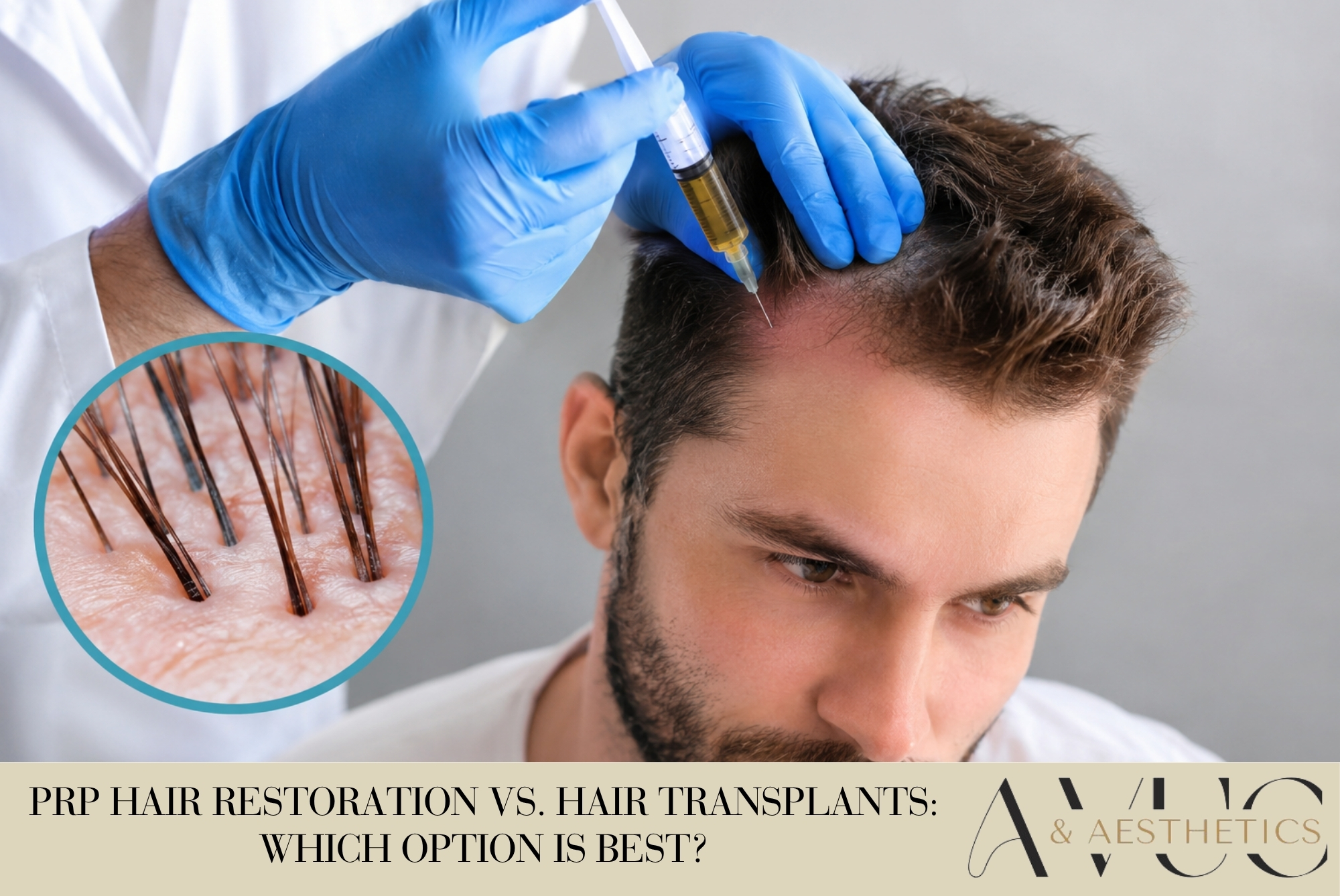
Hair thinning and hair loss can affect both men and women, and choosing the right treatment often depends on the cause, severity, and stage of hair loss. Two commonly discussed options are platelet-rich plasma (PRP) hair restoration and hair transplant surgery. While both approaches aim to improve the appearance of thinning hair, they work in very different ways.
PRP hair restoration is a nonsurgical treatment that uses a concentrated portion of a patient’s own blood to support existing hair follicles. A hair transplant, by comparison, is a surgical procedure that relocates hair follicles from a donor area to areas affected by hair loss.
So, is PRP better than a hair transplant? The answer depends on whether viable hair follicles are still present, how advanced the hair loss has become, the patient’s goals, and whether they prefer a nonsurgical or surgical approach.
At Apricot Valley Urgent Care & Aesthetics, patients in Patterson and Modesto, California, can discuss their hair concerns with a healthcare professional and learn whether PRP hair restoration may be appropriate for their individual needs.
What Is PRP Hair Restoration?
PRP stands for platelet-rich plasma. PRP treatments begin with a small blood draw. The blood is processed to separate and concentrate platelets within the plasma. This platelet-rich preparation is then administered to targeted areas of the scalp.
Platelets are best known for their role in blood clotting, but they also contain proteins and growth factors involved in normal tissue repair and cellular signaling. PRP hair restoration uses these concentrated components with the goal of supporting the environment around existing hair follicles.
PRP is not a hair transplant. It does not move follicles from one part of the scalp to another, nor does it create entirely new follicles where none remain.
How Does PRP for Hair Loss Work?
PRP is injected into areas of the scalp affected by thinning. Research has investigated whether these injections can help support follicular activity, hair density, and hair thickness in certain types of hair loss.
PRP is generally most relevant when hair follicles are still present. This distinction is important because a weakened or miniaturized follicle may potentially respond differently than an area where follicles are no longer viable.
Results vary substantially among individuals, and PRP should not be viewed as a guaranteed way to regrow lost hair.
Who May Be a Candidate for PRP Hair Restoration?
PRP may be considered for adults experiencing certain forms of hair thinning, particularly when follicles remain in the affected areas.
Potential candidates may include people experiencing:
Early-stage hair thinning
Pattern hair loss
Gradual reduction in hair density
Miniaturization of existing hair
A desire for a nonsurgical hair restoration approach
Not every type of hair loss should be treated cosmetically without first identifying its cause. Sudden, patchy, unexplained, or rapidly progressing hair loss can have multiple underlying causes and should be professionally evaluated.
What Is a Hair Transplant?
A hair transplant is a surgical hair restoration procedure. Rather than attempting to support existing thinning follicles, transplantation moves viable hair follicles from a donor region—commonly the back or sides of the scalp—to an area where additional hair coverage is desired.
Two commonly used approaches are follicular unit extraction (FUE) and follicular unit transplantation (FUT).
What Is FUE Hair Transplantation?
During follicular unit extraction, individual follicular units are removed from the donor region and implanted into recipient areas.
FUE avoids the linear donor incision associated with FUT, although small extraction sites are created throughout the donor region.
What Is FUT Hair Transplantation?
Follicular unit transplantation generally involves surgically removing a narrow strip of scalp containing viable follicles. Follicular units are then prepared from that tissue and transplanted into the recipient area.
Because FUT involves a surgical incision in the donor region, it generally produces a linear scar.
Who May Be a Candidate for a Hair Transplant?
Hair transplantation may be considered when hair loss is sufficiently established and a patient has an adequate supply of suitable donor hair.
Candidacy depends on factors such as:
The pattern and extent of hair loss
Donor hair density and quality
Scalp health
Age and anticipated progression of hair loss
Medical history
Expectations regarding coverage and density
A hair transplant does not necessarily prevent ongoing loss of non-transplanted hair. Long-term planning is therefore an important part of surgical hair restoration.
PRP Hair Restoration vs. Hair Transplants: Key Differences
The biggest difference between PRP and a hair transplant is that PRP works with existing follicles, while transplantation physically relocates follicles.
PRP is minimally invasive and does not require surgery. Hair transplantation is a surgical procedure involving follicle harvesting and implantation.
PRP typically involves a series of treatment sessions and may require maintenance treatments depending on the patient and treatment plan. Hair transplantation usually involves a surgical session followed by a longer healing and hair-growth process.
Another important difference is the stage of hair loss each approach may address. PRP may be more relevant when existing follicles are thinning or miniaturizing. A transplant may be considered when an area has experienced more advanced loss and suitable donor follicles are available.
Is PRP Better Than a Hair Transplant?
Neither treatment is universally better.
For someone with early or moderate thinning who wants a nonsurgical treatment, PRP may be worth discussing with a qualified healthcare professional. It can be performed without harvesting follicles or creating surgical donor sites.
For someone with substantial permanent hair loss and an adequate donor supply, a hair transplant may offer an option for adding follicles to areas where sufficient viable follicles are no longer present.
The better choice therefore depends on the condition of the scalp and follicles rather than simply which procedure is more intensive.
When Might PRP Be Preferred?
PRP may appeal to patients who want to address hair thinning without undergoing surgery.
It may be considered when:
Hair loss is relatively early
Existing follicles remain in the thinning area
The patient wants a minimally invasive procedure
Avoiding surgical incisions is important
The patient understands that multiple treatments may be recommended
The patient has realistic expectations regarding potential improvement
A professional assessment is important because visible thinning alone cannot determine whether PRP is the appropriate treatment.
When Might a Hair Transplant Be Preferred?
Hair transplantation may be considered for more established hair loss, particularly when the objective is to restore coverage in areas where existing follicular density is inadequate.
It may be more appropriate when:
Hair loss is advanced or well established
There is sufficient healthy donor hair
The patient is comfortable undergoing surgery
The goal requires relocating follicles into areas of significant loss
The patient’s overall pattern of hair loss makes transplantation appropriate
Hair transplantation requires careful evaluation and planning because donor follicles are a limited resource.
Can PRP Regrow Hair on a Completely Bald Area?
PRP relies on the presence of hair follicles. It cannot be expected to manufacture new follicles in an area where viable follicles are absent.
This is one reason early evaluation of progressive hair thinning can be valuable. Treatment possibilities may differ significantly between early follicular miniaturization and advanced hair loss.
A healthcare professional can evaluate the pattern of loss and discuss whether PRP is a reasonable option.
How Many PRP Hair Restoration Sessions Are Needed?
There is no universal PRP schedule appropriate for every patient. Treatment protocols vary according to the provider, individual hair-loss pattern, response to treatment, and other clinical considerations.
An initial series of treatments may be recommended, followed by reassessment and possible maintenance sessions.
Patients should follow the individualized treatment plan recommended by their healthcare professional rather than assuming that a specific number of sessions will guarantee a particular result.
How Long Does It Take to See PRP Hair Restoration Results?
Hair growth occurs gradually, so PRP should not be expected to produce an immediate cosmetic transformation.
When improvement occurs, changes in shedding, thickness, or density may become noticeable progressively over the months following treatment. Individual responses and timelines vary.
Because hair naturally grows in cycles, evaluating hair restoration typically requires patience and appropriate follow-up.
How Long Does a Hair Transplant Take to Show Results?
Transplanted hair also develops over time rather than immediately after surgery.
Some transplanted hairs commonly shed during the early postoperative period while the transplanted follicles remain in place. New growth can then develop gradually over subsequent months.
Final maturation and cosmetic results can take considerably longer than the initial surgical recovery.
Patients considering transplantation should discuss expected recovery and growth timelines with their hair transplant surgeon.
Does PRP Hair Restoration Require Downtime?
One advantage of PRP is that it is nonsurgical and generally involves less recovery than surgical transplantation.
Patients may experience temporary tenderness, redness, swelling, or sensitivity around injection sites. Individual experiences vary, and patients should follow all post-treatment instructions provided by their healthcare professional.
Hair transplantation typically involves a more extensive recovery process because both donor and recipient areas must heal.
Does PRP Hair Restoration Hurt?
PRP involves blood collection and scalp injections, so some discomfort is possible. Sensitivity varies from person to person.
Patients concerned about discomfort should discuss what to expect and what comfort measures may be available before treatment.
Are PRP Hair Restoration Results Permanent?
PRP should not generally be viewed as a one-time permanent cure for progressive hair loss.
Hair loss can continue because of genetics, aging, hormones, medical conditions, medications, nutritional factors, and other influences. Depending on the patient’s response and underlying condition, ongoing treatment or maintenance may be recommended.
A hair transplant can relocate follicles, but it likewise does not necessarily stop the progression of hair loss in surrounding, non-transplanted hair.
Can PRP and Hair Transplants Be Used Together?
PRP and hair transplantation are not necessarily competing treatments in every situation. Because they function differently, some hair restoration professionals may incorporate PRP into broader treatment plans for selected patients undergoing surgical restoration.
Whether this is appropriate depends on the individual and should be determined by qualified healthcare professionals involved in the patient’s care.
What Causes Hair Loss?
Understanding the cause of hair loss is important before selecting a treatment.
Hair thinning or loss can be associated with numerous factors, including genetics, hormonal changes, aging, physical or emotional stress, nutritional deficiencies, certain medications, medical conditions, autoimmune processes, scalp disorders, and damaging hair practices.
Androgenetic alopecia, commonly called male-pattern or female-pattern hair loss, is among the most common causes of progressive hair thinning.
However, not every case of hair loss is androgenetic alopecia. This is why evaluation can be particularly important when hair loss is sudden, severe, patchy, accompanied by scalp symptoms, or otherwise unusual.
Why Early Evaluation of Hair Thinning Matters
Hair restoration options can depend on whether follicles remain viable.
Someone who notices increasing scalp visibility, a widening part, reduced density, or progressive thinning may benefit from seeking an evaluation rather than waiting until hair loss becomes extensive.
Early evaluation does not mean every patient needs treatment. It provides an opportunity to better understand what may be causing the change and which options, if any, are appropriate.
PRP Hair Restoration in Patterson and Modesto, CA
Patients interested in nonsurgical hair restoration can contact Apricot Valley Urgent Care & Aesthetics to learn more about PRP hair restoration and whether it may be suitable for their concerns.
With locations in Patterson and Modesto, California, Apricot Valley Urgent Care & Aesthetics provides convenient access for patients in Stanislaus County and surrounding communities.
A consultation provides an opportunity to discuss the patient’s hair-loss history, goals, expectations, and potential treatment options.
Frequently Asked Questions About PRP Hair Restoration vs. Hair Transplants
What is the main difference between PRP and a hair transplant?
PRP is a nonsurgical procedure using platelet-rich plasma prepared from the patient’s own blood and administered to targeted areas of the scalp. A hair transplant is surgery that relocates follicles from a donor region to an area affected by hair loss.
Is PRP hair restoration surgery?
No. PRP hair restoration does not involve surgically removing and transplanting follicles. It does, however, involve a blood draw and scalp injections.
Does PRP create new hair follicles?
PRP does not create entirely new follicles. Its potential role is associated with supporting existing follicles, which is why the condition and viability of the follicles matter when evaluating candidacy.
Is PRP good for early hair loss?
PRP may be considered for some patients experiencing early or moderate thinning when viable follicles remain. The cause and pattern of hair loss should be evaluated before determining whether treatment is appropriate.
Is a hair transplant better for advanced baldness?
Hair transplantation may be considered when significant hair loss has occurred and a patient has sufficient healthy donor follicles. Candidacy requires an individualized surgical assessment.
Can women receive PRP for hair thinning?
Women experiencing certain forms of hair thinning may be candidates for PRP. Because female hair loss can have multiple causes, an appropriate evaluation is important before treatment.
Can men receive PRP for hair loss?
Yes. PRP may be considered for men with certain patterns and stages of hair thinning, depending on factors such as follicle viability and the underlying cause.
Can PRP stop genetic hair loss permanently?
PRP should not be considered a guaranteed permanent cure for genetic hair loss. Androgenetic alopecia can continue to progress, and ongoing management may be necessary.
Is PRP safer than a hair transplant?
PRP avoids many of the considerations associated with surgery because it does not require follicle harvesting or surgical incisions. However, every medical procedure has potential risks and limitations. Individual suitability should be assessed by a qualified healthcare professional.
Does a hair transplant stop future hair loss?
Not necessarily. Transplanted follicles may provide coverage in treated areas, but existing non-transplanted hair can continue thinning. Long-term hair-loss management may therefore remain important.
How quickly can I return to normal activities after PRP?
Because PRP is nonsurgical, recovery is generally shorter than recovery following hair transplantation. Exact activity recommendations depend on the procedure and individual circumstances, so patients should follow their provider’s instructions.
How do I know whether my follicles are still active?
It can be difficult to determine follicular viability simply by looking in the mirror. A professional evaluation of the scalp, pattern of hair loss, and medical history can help determine which treatment options may be reasonable.
What if my hair loss started suddenly?
Sudden or unexplained hair loss deserves medical attention because hair loss can have causes other than hereditary pattern thinning. Identifying the underlying issue may be more important than immediately pursuing a cosmetic hair restoration procedure.
Is PRP the same as a hair transplant?
No. PRP does not relocate hair follicles. Hair transplantation surgically transfers follicles from one area to another. The treatments have different purposes, procedures, recovery requirements, and potential candidates.
Which has less downtime: PRP or a hair transplant?
PRP generally involves less downtime because it is nonsurgical. Hair transplantation requires healing of both donor and recipient areas.
Which option looks more natural?
Natural-looking results can depend on appropriate patient selection, the degree and pattern of hair loss, treatment response, and—in transplantation—the surgeon’s planning and placement of grafts. Neither treatment can guarantee a specific cosmetic outcome.
Can I get PRP before considering a hair transplant?
Some patients with viable follicles and earlier-stage thinning may consider nonsurgical approaches before surgical restoration. Whether this strategy is appropriate depends on the cause and extent of hair loss.
How do I choose between PRP and a hair transplant?
Consider the stage and cause of your hair loss, whether viable follicles remain, your desired level of intervention, tolerance for downtime, expectations, and recommendations from qualified healthcare professionals.
For patients interested in avoiding surgery and addressing thinning while follicles remain, PRP may be an option worth discussing. Patients with more advanced loss may need to consult a qualified hair transplant specialist to determine whether surgical restoration is appropriate.
Schedule a PRP Hair Restoration Consultation
There is no single hair restoration treatment that is best for every patient. PRP and hair transplantation address hair loss differently, and appropriate treatment begins with understanding the individual’s pattern of thinning and goals.
If you are experiencing thinning hair and would like to learn whether PRP hair restoration may be an option, contact Apricot Valley Urgent Care & Aesthetics.
Patients can schedule an appointment at the Patterson or Modesto location to discuss their concerns and available treatment options.
Contact Information
Apricot Valley Urgent Care & Aesthetics
Patterson Location
1108 Ward Ave, Bldg A, Suite 2
Patterson, CA 95363
Modesto Location
3401 Dale Road, Suite 642-A
Modesto, CA 95356
Phone: (209) 843-0434
Website: avucandaesthetics.com
Appointments: avucandaesthetics.com/appointments